Quick Answer
Moisture mapping is a documented inspection that combines infrared thermal imaging with pin and pinless moisture meters to locate hidden water inside walls, floors, ceilings, and cavities. It tells us exactly where to dry, where to remove material, and where to leave your home alone. Royal Run Water Restoration provides this assessment free for Royal Run homeowners, and our crews are typically on site within 2 hours of your call.
What Thermal Imaging Actually Sees
A thermal camera does not see water. It sees temperature. Wet materials evaporate moisture, which cools them slightly compared to dry surrounding materials. That temperature delta shows up on screen as a darker patch, a tongue creeping under a baseboard, or a fan shaped pattern spreading from a leak point in a ceiling.
Because thermal cameras read surface temperature only, every suspicious area must be confirmed with a moisture meter. A cold spot could be wet drywall, or it could be a stud, a pipe, or air leakage around a window. The meter settles the question.
Lighting conditions, recent HVAC activity, and even direct sunlight on an exterior wall can throw off a thermal scan. We turn off ceiling fans, close exterior doors, and let the indoor air stabilize for several minutes before starting. On exterior walls hit by afternoon sun, we may schedule a return scan in the early morning when surface temperatures are more uniform. These small habits prevent false positives that waste your time and your insurance dollars.
Tools We Use on Every Royal Run Job
- Infrared thermal camera with a sensitivity below 0.1 degrees C
- Pinless moisture meter for fast surface scans on drywall and wood
- Pin type moisture meter for depth readings inside framing
- Thermo hygrometer to measure ambient temperature and relative humidity
- Borescope camera for direct visual inspection inside wall cavities
- Manometer for pressure testing in suspected vapor intrusion areas
Reading the Numbers
Moisture content is reported as a percentage. The acceptable range depends on the material and your local baseline. Below is what we typically use for Royal Run homes:
| Material | Dry Standard | Action Threshold | Saturated |
|---|---|---|---|
| Drywall | Under 1% | 1% to 17% | Over 17% |
| Framing lumber | 9% to 14% | 15% to 19% | 20% and above |
| Hardwood flooring | 6% to 9% | 10% to 15% | Over 16% |
| Concrete slab | Under 4% | 4% to 6% | Over 6% |
| Carpet pad | Dry to touch | Damp | Squeezable water |
Baseline matters. A Royal Run home in mid summer will read higher across the board than the same home in winter, simply because outdoor air carries more moisture. We always pull readings from an unaffected room on the same floor to establish what "normal" looks like in your specific house on that specific day. Without that anchor, a 12% reading on framing lumber could mean nothing or could mean everything.
How a Moisture Map Gets Built
The map itself is a floor by floor sketch of your affected areas with readings noted at each test point. Insurance adjusters expect this documentation, and good restoration companies expect to provide it. Here is the order we work in:
- Walk the loss area with the thermal camera, marking cool zones with painter's tape
- Confirm each marked zone with a moisture meter and record the reading
- Take a baseline reading from an unaffected area of the same material for comparison
- Measure ambient temperature and humidity to set drying goals
- Photograph thermal images alongside meter readings for the file
- Sketch the affected zones on a room diagram with cardinal directions noted
This same approach is critical when tracing water damage behind walls from a slow plumbing leak, where the visible stain may be feet away from the actual source.
What the Map Tells Us to Do
Mapping is not just diagnosis. It drives every decision that follows. The readings determine whether material gets dried in place, partially removed, or fully removed.
Dry in Place
- Drywall readings under 17% with no visible swelling or staining
- Hardwood with surface moisture but stable subfloor readings
- Concrete with elevated readings and no finished flooring above
- Tile floors over a wet subfloor where the tile and grout are intact
Controlled Demolition Required
- Insulation that has wicked water (it does not dry in place reliably)
- Drywall saturated above 17% for more than 48 hours
- Carpet pad in any Category 2 or Category 3 event
- Engineered wood flooring with delamination starting
- MDF baseboards or trim showing visible swelling at the joints
Why Mapping Matters for Mold Prevention
Mold spores need moisture, organic material, and time. Most species can colonize wet drywall or framing within 24 to 72 hours. If a moisture map misses a wet cavity, that hidden pocket becomes a mold problem two weeks later. This is why the 48 hour rule drives our urgency. Finding every wet area on day one is the cheapest mold prevention you can buy.
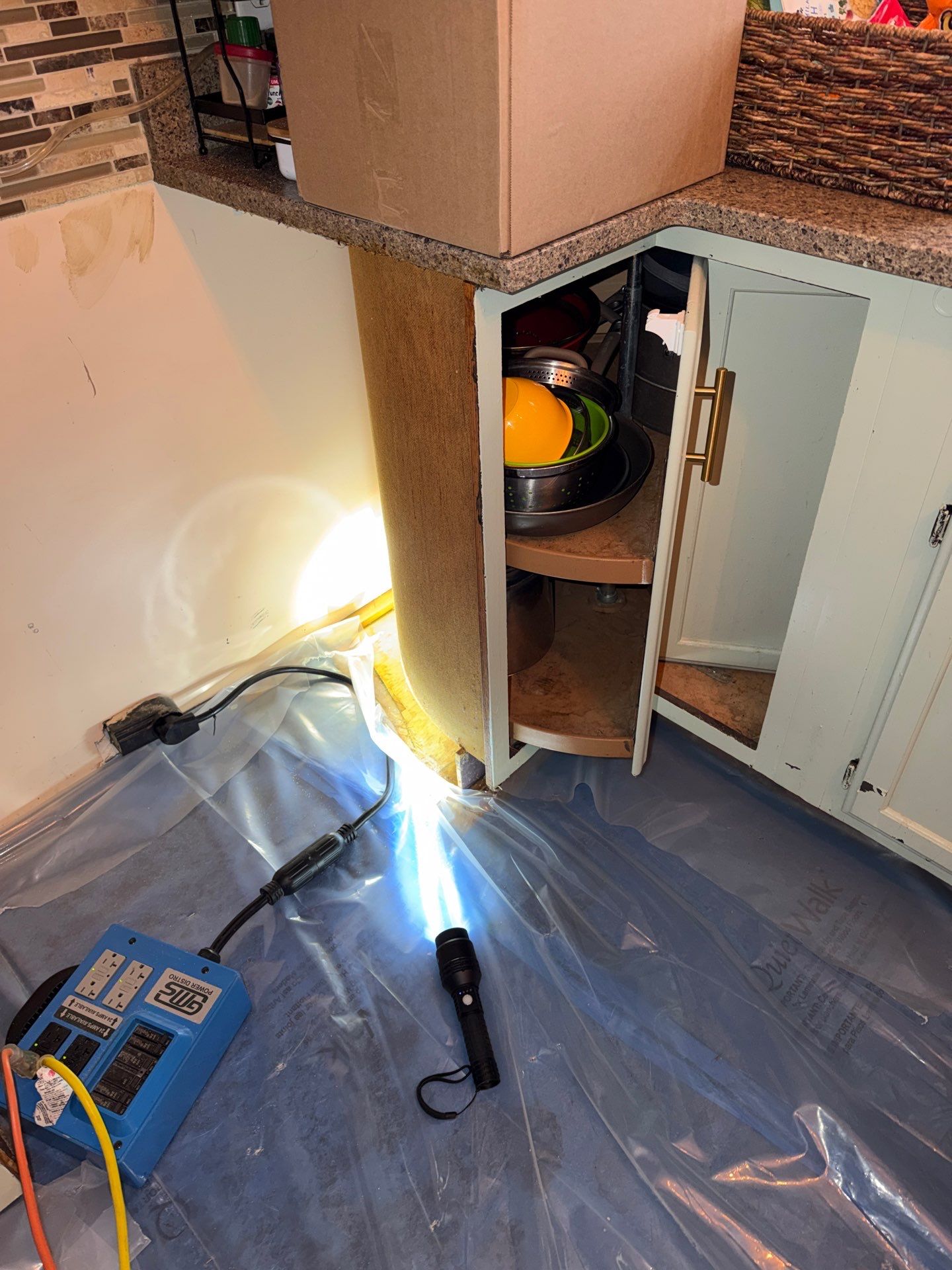
The riskiest spots are almost always the ones you cannot see from the room itself. Wall cavities behind kitchen cabinets, the underside of stair stringers, the void between a tub and the framing, and the dead space above a dropped ceiling all trap moisture and hide it from casual inspection. A thorough map checks each of these zones even when the visible damage seems limited to one wall.
What You Should Receive From Any Restoration Company
- A written or sketched map of moisture affected areas in your home
- Numeric readings, not just "wet" or "dry" notes
- Thermal photos paired with the meter readings that confirmed them
- Daily progress readings throughout the drying phase
- A final clearance reading showing materials returned to dry standard
- A clear sign off date and the technician's name on every entry
If a contractor cannot produce this documentation, your insurance claim is harder to defend and your home is more likely to develop secondary damage. Ask for the map. A reputable Royal Run restorer will hand it to you without being asked twice.